Washing Machine Leak Water Damage: Causes, Cleanup and the Floor Below
Washing machine leak water damage usually starts at one of four places: a supply hose, the drain hose, the door seal or the pump. Turn the machine off, close the two supply valves behind it, and then look at where the water went, not only at the puddle. In a New York City apartment, the bigger damage is often out of sight, in the subfloor and the ceiling of the unit below.
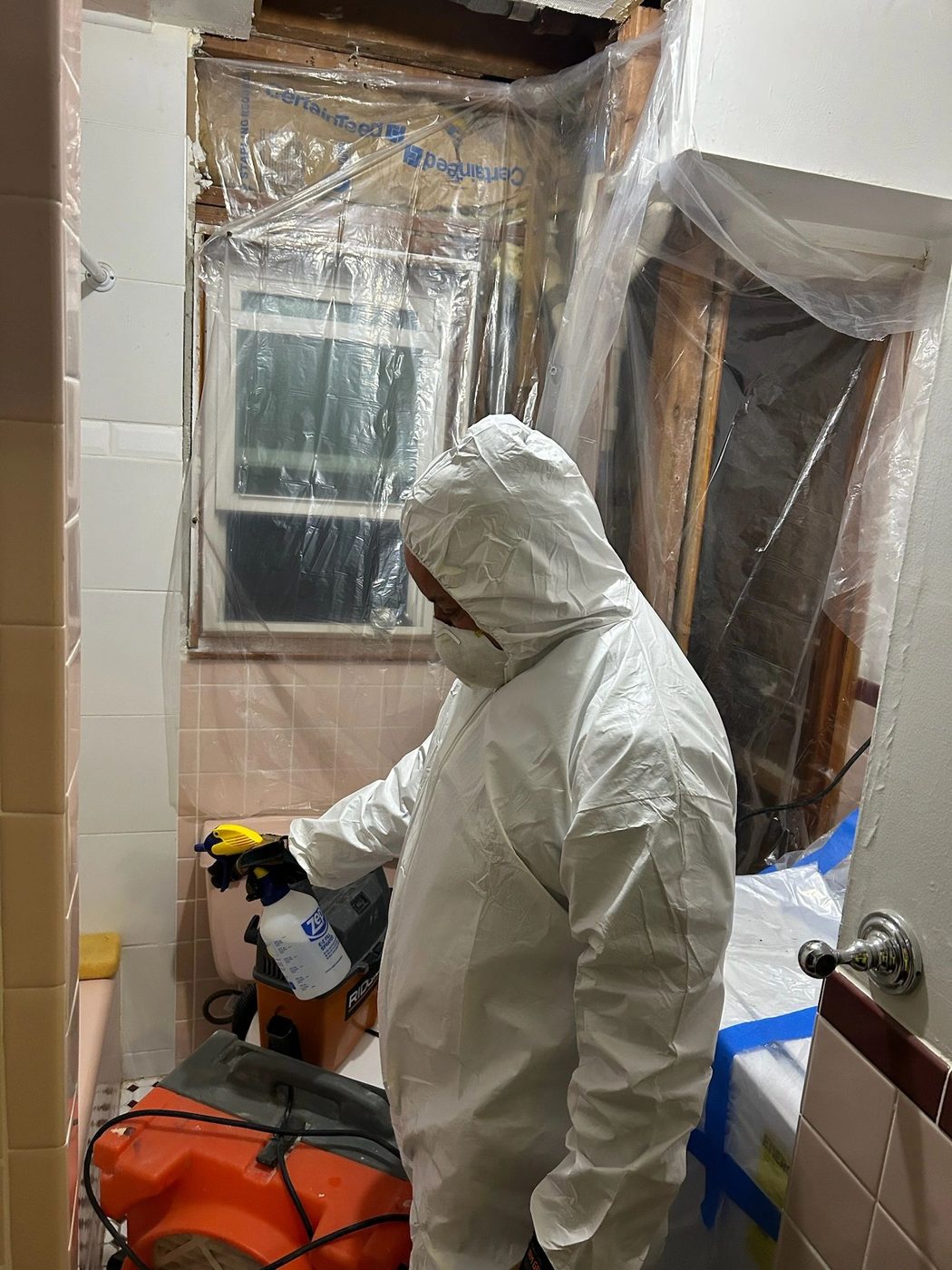
A GlobePro Restoration technician setting up containment and drying in a water-damaged bathroom.
Stop the water before anything else
- Turn the washer off. Unplug it only if you can reach the plug without standing in water.
- Close both supply valves. The hot and cold valves are on the wall behind the machine. A burst hose keeps pouring at full water pressure until they're closed, whether the washer is running or not.
- Can't reach them? Close the shutoff for the apartment or house, or get the super to close the line.
- Get things off the floor. Laundry baskets, cardboard boxes and rugs soak up water and spread it.
- Take photos of the machine, the hoses, the water on the floor and any stain on the ceiling below.
Where a washing machine leak usually starts
If you're asking why your washing machine leaks water underneath, the timing of the leak is the best clue.
- Supply hoses. Water behind the machine when it fills, or a steady flow even when it's off, points to a supply hose or its connection. In a 2011 consumer pamphlet, Connecticut's Insurance Department passed along an Institute for Business & Home Safety finding that a burst supply line caused half of all the water damage incidents involving washing machines in that study. Cracks, kinks and blisters are most common near the hose connection.
- Drain hose and standpipe. Water that shows up while the machine drains or spins usually comes from the drain side: a hose that slipped out of the standpipe, a cracked hose, or a clogged standpipe that overflows. A machine that keeps filling past its normal level, often a failed inlet valve or water-level sensor, can overflow too.
- Door seal. On a front-loader, water at the front of the machine during the wash often means a torn or dirty door gasket, or a sock caught in it.
- Pump and internal hoses. Water under the machine during the drain cycle, with the outside hoses dry, usually means the pump or an internal hose. That's an appliance repair.
- Load and level. Too much detergent, an overloaded drum or a machine that isn't level can all push water out where it shouldn't go.
Is water damage from a washing machine clean water?
It depends which side of the machine it came from.
Water from a supply hose comes straight from the building's pipes, so it starts out clean, what the restoration trade calls Category 1. Water from the drain side is different. In the trade's standard shorthand, discharge from a washer or dishwasher is a typical example of Category 2, or gray water: water with significant contamination.
That changes the order of work. Under the IICRC's S500 standard, a Category 1 job can proceed without contamination controls, but for Category 2 or 3 water, remediation should come before restorative drying, with contamination controls and worker protection. The EPA also says not to use fans until you have determined that the water is clean or sanitary.
If water came up out of a floor drain or the standpipe while the washer emptied, the blockage may be in the building's drain line, a bigger problem covered in our guide to toilet overflow cleanup.
The floor below: washers over another apartment
A washer on an upper floor, in a two-family house or an apartment with its own laundry, sits over somebody else's ceiling. Water that gets under the machine runs into the subfloor and can travel along the joists before it shows up as a stain one floor down, sometimes not directly under the washer.
- Tell the neighbor below and the super right away. In a rental, 311 says to start with the landlord, managing agent or super; in a co-op or condo, with management or the board. If that fails, a 311 complaint about a leak inside an apartment goes to HPD.
- Look at the floor around the machine. Wood and laminate can swell and lift at the seams when water gets under them. Our guide to water-damaged hardwood floors covers what can be saved.
- Watch the clock. The EPA says that in most cases mold will not grow if wet or damp items are dried within 24 to 48 hours. Wet carpet and pad have to come up off the floor to dry.
GlobePro Restoration finds every place the water got in, including the floor and ceiling below, and dries out all the affected areas, working with your insurance company along the way. If water from a washer is in your floor now, call (929) 969-2534 for water damage restoration, day or night.
Does insurance cover washing machine water damage?
Coverage can turn on whether the damage was sudden or gradual. New York's Department of Financial Services says a homeowners policy is purchased to cover "sudden and unexpected large losses." A hose that burst and a seal that seeped for months may be treated differently, so read your policy's water and maintenance wording and ask your insurer.
For renters, DFS lists water from plumbing failure, appliance failure, fire sprinklers and other accidental discharges among the things a renters policy typically covers, and says a policy may also cover damage you cause to other people's property. It adds that the landlord's insurance generally won't protect a tenant's belongings.
When you file, DFS says to notify your insurer first and to make no permanent repairs until the insurer has inspected. Under state insurance regulation 11 NYCRR 216.6, the insurer then has 15 business days to accept or reject the claim in writing, or to tell you it needs more time, counted from when it receives a properly executed proof of loss and every item it asked for.
Keep the next one from happening
The same 2011 Connecticut pamphlet listed simple habits:
- Inspect the supply hoses every six months for cracks, kinks or blisters, especially near the connections.
- Replace the hoses every five years, which it says washer manufacturers recommend, and consider reinforced braided stainless steel hoses.
- Leave 3 to 4 inches between the back of the machine and the wall so the hoses don't kink.
- Don't run the washer when nobody is home, and turn the supply valves off when it's not in use.
Frequently asked questions
Why does my washing machine leak water underneath?
Usually a supply hose, the drain hose, the door seal or the pump. Water when it fills points to the supply side; water while it drains points to the drain hose, the standpipe or the pump.
Is water from a washing machine leak dirty?
Water from a supply hose starts clean. Drain water from the machine is generally treated as gray water, Category 2, which means no fans until it has been cleaned up.
Who pays if my washer leaks into the apartment below?
It depends on the cause, your lease and the policies involved. DFS says a renters policy may cover damage you cause to other people's property, so call your insurer early.
Should I file a claim for a small washer leak?
That's your call. DFS notes that several small claims in a short period can lead some carriers to non-renew a homeowners policy, and that for minor damage you may want to consider paying out of pocket.
Does GlobePro Restoration work with my insurance company?
Yes. GlobePro Restoration works with your insurance company to make the process as smooth as possible.
Water under the washer right now?
Call (929) 969-2534, any hour, or send a request. GlobePro Restoration is based in Brooklyn and handles water damage across New York City.
More from the blog
- Water Damage Restoration in Manhattan: Co-ops, Condos and Prewar Walk-Ups
- Water Leak From the Upstairs Apartment in NYC: First Steps and Who Pays
- Flood Cleanup in Brooklyn's Coastal Neighborhoods, 14 Years After Sandy
- Water Damage Restoration in Queens, NY: Basements, Attached Homes and Flash Floods
- Steam Pipe Burst or Radiator Leak in Your NYC Apartment: What to Do When the Heat Comes On