Water Damage Restoration in Manhattan: Co-ops, Condos and Prewar Walk-Ups
Water damage restoration in Manhattan runs in the usual order: shut off the water, trace where it traveled, and dry it out before mold can grow. What changes is the building. In a co-op, condo, rental or prewar walk-up, the super usually controls the shutoff valves, the managing agent sets the rules for contractors, and by the time anyone notices a stain the water has often reached more than one apartment.
GlobePro Restoration answers (929) 969-2534 around the clock, for leaks below 14th Street and above 200th.
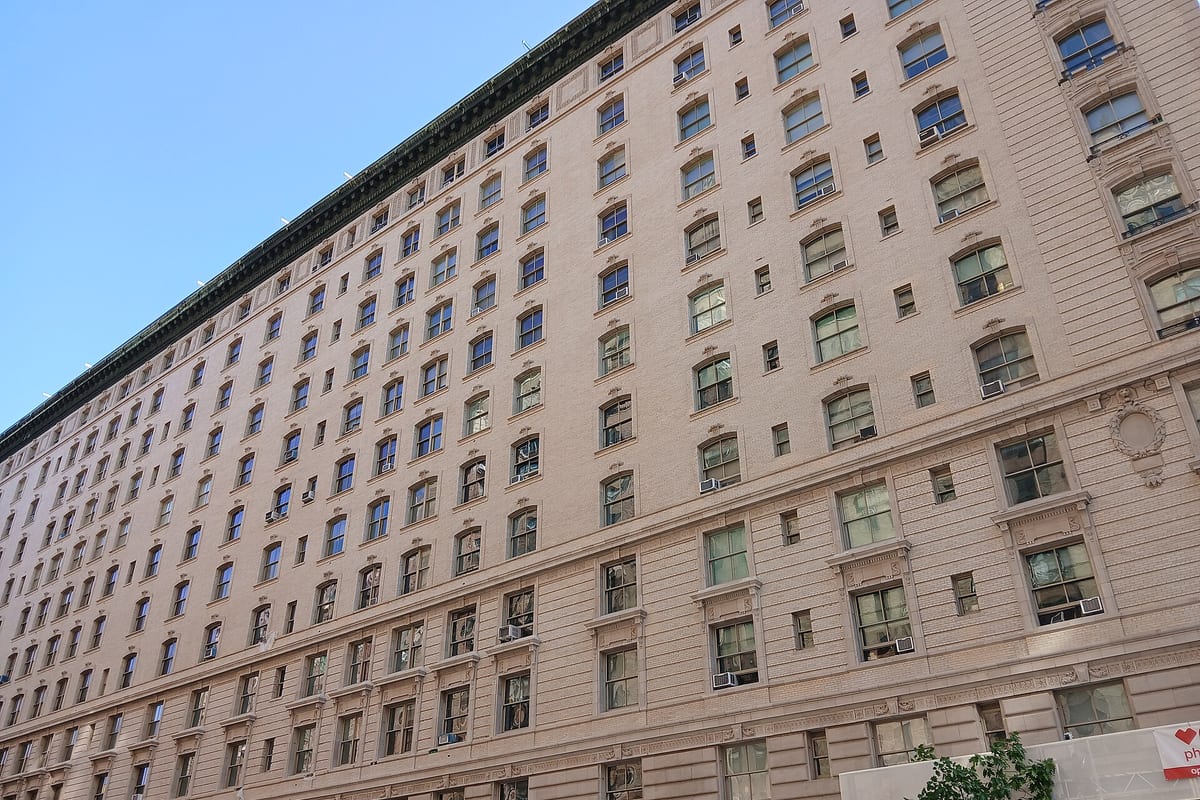
The Belnord, Upper West Side. Photo: Epicgenius, CC BY-SA 4.0, via Wikimedia Commons.

Who runs a water job inside a Manhattan building
Start with the people who can reach the valves. The city's 311 guidance on building leaks says to try your landlord, managing agent or super before filing a complaint. In a co-op or condo, report it first to the owner, the management company or the board. If nobody fixes it, a 311 complaint goes to HPD, which contacts the managing agent and can send an inspector. Call 911 if there is immediate danger.
Many co-ops and condos also have house rules for contractors. Before a drying crew shows up, it helps to ask the managing agent or the super:
- Which hours contractors may work, and whether weekends are different.
- Whether the service elevator has to be booked, and how equipment should come in.
- What the building wants in writing before work starts.
- Who can open the apartments above and below, since the drying may need to reach them.
Then call your insurer. Per New York's Department of Financial Services, the insurer gets the first call, followed by a written notice. Keep the apartment from getting worse and save the receipts for temporary fixes. Permanent repairs should wait for the insurer's inspection; DFS warns that a company can decline to pay for damage fixed before it looks.
Water damage restoration in Manhattan: what GlobePro Restoration does
GlobePro Restoration's part starts with tracking down every spot the water reached, including the units below, and drying each one out; repairs wait until everything is dry. We coordinate with your insurance company to keep the process as smooth as possible, and our 24/7 water damage restoration covers all of Manhattan.
Time is the reason to call early. The EPA gives a 24-to-48-hour window: dry wet materials inside it and, in most cases, mold won't grow. That clock starts when the water does.
Prewar walk-ups, radiators and the apartment upstairs
Older Manhattan buildings tend to line up their kitchens and bathrooms floor over floor, with shared supply and drain lines running between them. When one of those lines fails, the stain can appear two or three floors below the leak, and every apartment in between may be wet inside the walls. If the water is coming down from above you, our guide to water leaking from the apartment upstairs walks through who to call and what to document.
Steam heat adds a seasonal source. HPD's heat season runs October 1 to May 31, so radiators and risers that sat idle all summer are back in use every fall. Steam can scald, so leave the valve to the super; the radiator and steam pipe leak guide covers what to do in the meantime.
Plaster and drywall both hide water. A ceiling can feel dry and still be wet above the surface. The EPA says drywall can be dried in place when there is no obvious swelling and the seams are intact, and has to be removed otherwise.
Storm surge downtown, flash floods uptown
Manhattan escaped the worst of Hurricane Ida in 2021. The city's Ida recovery plan put only 2.0% of the damaged buildings in Manhattan, and it was the one borough left eligible for FEMA's Public Assistance only, not Individual Assistance.
Heavy rain still finds the basements. On October 30, 2025, NBC News reported that a man died in a flooded boiler room in Washington Heights after a downpour that put 1.85 inches of rain on Central Park.
Superstorm Sandy, on October 29, 2012, came from the harbor. The National Weather Service reports a storm tide of 14.06 feet above mean lower low water at the Battery. Storm reports compiled by the agency logged Hudson River water across the West Side Highway reaching 10th Avenue, the FDR Drive flooded under Houston Street, and water 3 feet deep inside a Lower Manhattan building with 6 feet outside. Battery Park City, built on a raised site, came through largely unscathed, according to the city's recovery report. Forty-three New Yorkers died in the storm.
In big buildings, a flooded basement meant trouble upstairs. The NYU Furman Center found in 2013 that many public housing residents lost heat and electricity because the basements where those systems sat had flooded, and that subsidized buildings in the surge zone were concentrated in places including Harlem and the Lower East Side. Seawater is a different job from a pipe leak, too: seawater flooding appears among the S500 standard's examples of Category 3, grossly contaminated water, according to the IICRC.
Downtown, FloodHelpNY lists Lower Manhattan among the areas for its free backwater valve program for eligible low-to-moderate-income building owners. Check the site for your address.
Manhattan neighborhoods and ZIP codes GlobePro Restoration serves
- Inwood and Washington Heights: 10031, 10032, 10033, 10034, 10040
- Central Harlem: 10026, 10027, 10030, 10037, 10039
- East Harlem: 10029, 10035
- Upper West Side: 10023, 10024, 10025
- Upper East Side: 10021, 10028, 10044, 10065, 10075, 10128
- Chelsea and Clinton: 10001, 10011, 10018, 10019, 10020, 10036
- Gramercy Park and Murray Hill: 10010, 10016, 10017, 10022
- Greenwich Village and Soho: 10012, 10013, 10014
- Lower East Side: 10002, 10003, 10009
- Lower Manhattan: 10004, 10005, 10006, 10007, 10038, 10280, 10282
GlobePro Restoration is based in Brooklyn; the other boroughs and the surrounding areas are covered as well.
Frequently asked questions
Who pays for water damage in a Manhattan co-op?
It depends on where the water came from and what the proprietary lease says. According to Habitat magazine, a radiator leaking inside a unit falls to the shareholder "99.9% of the time," while a neighbor's overflowing or broken fixture is the neighbor's problem. Ask the managing agent and your insurer before assuming.
Can I start drying before the insurance adjuster comes?
Yes, for anything that stops the damage getting worse; DFS says it is important to protect the property, and to keep receipts for temporary fixes. What waits is permanent repair, until the insurer has inspected. Photograph everything first and tell your insurer what is being done.
Does Manhattan flood like the outer boroughs?
Not in Ida: Manhattan had 2.0% of the buildings that storm damaged. But Sandy's surge flooded Lower Manhattan, and flash floods still reach basements and boiler rooms uptown.
Is GlobePro Restoration open at night and on weekends?
Yes. GlobePro Restoration is open 24 hours a day, 7 days a week. Every job is quoted individually.
Water coming through a Manhattan ceiling right now?
Call (929) 969-2534 at any hour, or send a request. You can see everything else we do on the services page.
More from the blog
- Water Leak From the Upstairs Apartment in NYC: First Steps and Who Pays
- Flood Cleanup in Brooklyn's Coastal Neighborhoods, 14 Years After Sandy
- Water Damage Restoration in Queens, NY: Basements, Attached Homes and Flash Floods
- Steam Pipe Burst or Radiator Leak in Your NYC Apartment: What to Do When the Heat Comes On
- Water Damage in Brooklyn Rowhouses, Walk-Ups and Basements