Flood Cleanup in Brooklyn's Coastal Neighborhoods, 14 Years After Sandy
Flood cleanup in Brooklyn depends on where the water came from. Water that surged in from the harbor or the ocean, or rose up through a basement floor drain, is generally treated as contaminated, so it is cleaned out and disinfected before any drying starts. Water from a broken supply pipe usually starts clean and can go straight to drying. Superstorm Sandy hit New York 14 years ago today, on October 29, 2012, and the flood it pushed into coastal Brooklyn was seawater.
GlobePro Restoration is a 24/7 restoration company based in Brooklyn. If water is in your home right now, call (929) 969-2534.
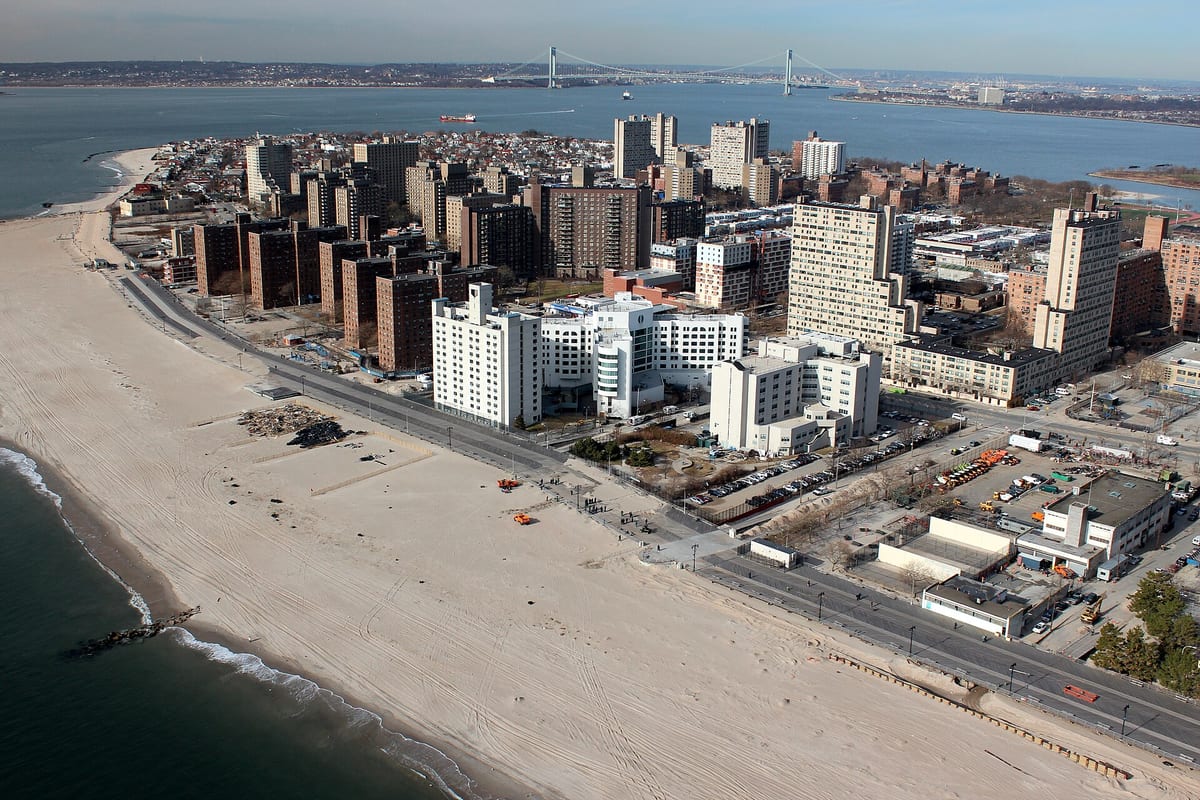
Sea Gate, Brooklyn, Dec. 6, 2012. Photo: U.S. EPA, Public domain, via Wikimedia Commons.

What Sandy did to coastal Brooklyn
Forty-three New Yorkers died in the storm, according to the city's post-Sandy resiliency report. The same report describes people from every borough heading to the Rockaways and Red Hook, to Coney Island and Staten Island, "and to other hard-hit communities" with food, generator fuel and their own hands.
The National Weather Service's storm reports from that night give a sense of the depth. Two broadcast reports from Coney Island, both estimating from photos, put the water at 2 to 3 feet and at 3 to 4 feet, and another reported the Brooklyn-Battery Tunnel flooded. At the Battery, at the tip of Manhattan, the water peaked 14.06 feet above mean lower low water, a 9.41-foot surge stacked on top of the tide.
In a rowhouse or a two-family home near the water, a flood like that fills the cellar or basement first. That is often where the boiler, the water heater and the electrical panel sit, which is why a surge can leave a house without heat or power long after the street has drained.
Flood cleanup in Brooklyn: why surge water is a different job
The restoration industry's water damage standard, IICRC S500, sorts water into three categories. Category 3 is "grossly contaminated," and the examples the standard gives can include sewage, flooding from seawater, and rising water from rivers or streams. For contaminated water, it puts cleanup ahead of drying.
Rain is less clear-cut. In March 2026 the committee behind the standard said weather-related water, including wind-driven rain, is not automatically Category 3: it depends on whether the water is actually grossly contaminated. Surge from the harbor is seawater, which is one of the listed examples.
The EPA's advice is to hold off on fans until you know the water is clean or sanitary. For a basement that took salt water or sewer water, the city's sewer backup and flood clean-up guide asks you to wear rubber boots, gloves and goggles, not to run electrical equipment near standing water, and to throw out anything that can't be cleaned, disinfected and dried, from mattresses to carpet padding. Children, pets and anyone with a weakened immune system should stay out until it's done.
Rain floods Brooklyn basements too
Sandy was surge. Brooklyn basements also flood when rain overwhelms the sewers, and when a sewer backs up, DEP says the water usually enters basements through plumbing fixtures such as floor drains.
On October 30, 2025, NBC News reported, heavy rain dropped 2.79 inches on Sheepshead Bay, and two people died in flooded rooms: one in a basement in East Flatbush, one in a boiler room in Washington Heights.
To see whether your block floods in a downpour, use the city's Stormwater Flood Maps, which model four rainfall scenarios from 1.77 to 3.66 inches an hour. The shading marks "nuisance" flooding of 4 inches to under a foot and "deep and contiguous" flooding of a foot or more. Read the map viewer's notice, though: it covers rain only and says it does not represent risk from storm surge. A block near the water needs a coastal flood zone check as well, and FloodHelpNY, run by the Center for NYC Neighborhoods, has an address search for that.
Southern Brooklyn's free backwater valve program
A backwater valve is a flap on a building's sewer line that swings shut when sewer water starts flowing back toward the house. FloodHelpNY lists a Residential Backwater Valve Installation Program it calls completely free, for eligible owners in four southern Brooklyn areas: the Southeast Brooklyn Waterfront, Gravesend and Bensonhurst, Gerritsen Beach and Sheepshead Bay, and the Southern Brooklyn Peninsula.
The conditions are strict:
- Only building owners can apply. Renters can pass the program along to their landlord.
- The property must have been the owner's primary residence during Hurricane Sandy.
- For now it serves low- to moderate-income households, at or below 80% of area median income.
- You need homeowners insurance, plus flood insurance if the property is in an AE zone.
- In Red Hook and Canarsie, only owners who completed FloodHelpNY's Home Resiliency Audit and counseling are being considered.
The site doesn't say clearly whether new applications are open, so look up your address there before you count on it.
What cleanup involves, and what to do first
Photograph before you throw anything out. New York's Department of Financial Services wants photos or video of the damage taken before any cleanup, emergency repairs limited to what stops further damage, and permanent repairs held until your insurer has inspected. DFS also notes that standard homeowners policies exclude flooding, which is covered through a separate National Flood Insurance Program policy.
Then the water comes out. GlobePro Restoration finds every place the water got in and dries out all the affected areas, and once everything is dry, the repairs begin. We work with your insurance company to make the process as smooth as possible. For 24/7 water damage restoration anywhere in Brooklyn, call (929) 969-2534. If your building is a rowhouse, a brownstone or a walk-up, our guide to water damage restoration in Brooklyn explains how water travels through each.
Speed still matters once the water is gone. The EPA's guidance is that mold usually won't grow on wet materials dried within 24 to 48 hours.
Coastal Brooklyn ZIP codes
- Southern Brooklyn: 11223, 11224, 11229, 11235
- Red Hook: 11231
GlobePro Restoration also serves the rest of New York City and the surrounding areas.
Frequently asked questions
Is storm surge water Category 3?
Under the IICRC S500 standard, flooding from seawater is one of the listed examples of Category 3, grossly contaminated water. Rain that comes in through a window is not automatically Category 3; it depends on what the water picked up.
Does the NYC stormwater flood map show storm surge?
No. The viewer's own notice limits it to rain-driven flooding; storm surge and coastal inundation aren't part of it. Check your coastal flood zone separately, for example with FloodHelpNY's address search.
Can I get a free backwater valve in southern Brooklyn?
Possibly. FloodHelpNY lists a free program for eligible low- to moderate-income building owners in parts of southern Brooklyn, and renters can't apply. Check the site to see whether your address qualifies and whether applications are open.
Does homeowners insurance cover flood cleanup?
Usually not for flooding itself. New York's Department of Financial Services says flood damage is typically covered only by a flood insurance policy, and some insurers sell a separate add-on for sewer backups. Ask your insurer what your policy covers.
Does GlobePro Restoration work with my insurance company?
Yes. GlobePro Restoration works with your insurance company to make the process as smooth as possible.
Water in your Brooklyn basement?
We answer 24 hours a day, 7 days a week. Call (929) 969-2534 or send a request, and see the full list of GlobePro Restoration services.
More from the blog
- Water Damage Restoration in Manhattan: Co-ops, Condos and Prewar Walk-Ups
- Water Leak From the Upstairs Apartment in NYC: First Steps and Who Pays
- Water Damage Restoration in Queens, NY: Basements, Attached Homes and Flash Floods
- Steam Pipe Burst or Radiator Leak in Your NYC Apartment: What to Do When the Heat Comes On
- Water Damage in Brooklyn Rowhouses, Walk-Ups and Basements