Water Leak From the Upstairs Apartment in NYC: First Steps and Who Pays
A water leak from the upstairs apartment in NYC is a race to stop the source. Knock on the door above, call your super, doorman or managing agent to get the water shut off, stay clear of wet light fixtures and any sagging ceiling, and photograph everything before you move it. Who pays comes after, and in New York it turns on whether you rent, own a co-op or own a condo, and on where the water started.
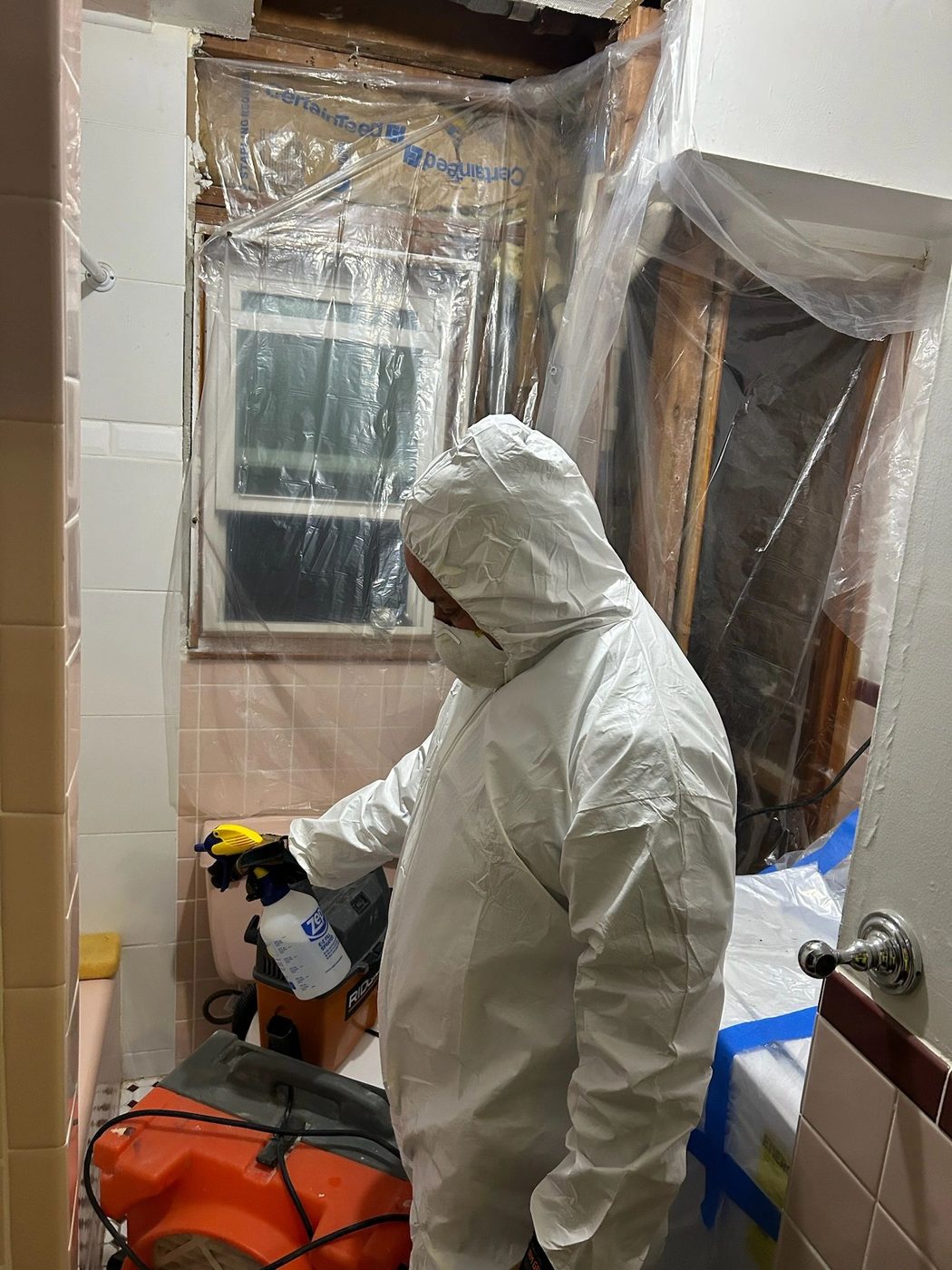
A GlobePro Restoration technician setting up containment and drying in a water-damaged bathroom.
Water leak from the upstairs apartment: the first hour
Safety. If water is coming through a light fixture, pooling near outlets, or the ceiling is bulging, stay out from under it and away from it. Call 911 if there is immediate danger, as 311 advises.
Stop the source. Knock upstairs. An overflowing tub or toilet stops when someone turns it off, and many fixtures have their own shutoff valve. If nobody answers, or the water is coming from a pipe inside a wall, you need building staff. Habitat magazine's advice for co-ops: call the doorman, then the super, and the managing agent during the week. A super or porter will get the water off faster than a board member.
Protect what you can. Move electronics, rugs, books and papers out of the drip line, put down buckets and towels, and cover what you can't move with plastic.
Photograph it and write it down. New York's Department of Financial Services (DFS) tells people to photograph or video the damage before cleaning anything up. Note when the water started and stopped, who you spoke to and what they said. A 2009 Cooperator Q&A, quoting two co-op attorneys, recommended a log of the date, time and description of each leak and of the building's response.
Who to call, and what 311 can do
Start with your landlord, managing agent or super, as the 311 guidance for a leak in a building says. Co-op and condo residents report first to the owner, management company or board, since their agreements can decide who must fix what.
If the building doesn't act, a 311 complaint about a leak in an apartment goes to HPD. HPD tries to reach the managing agent, calls you back to ask whether the leak was fixed, and sends a Code Enforcement inspector if it wasn't, without telling the owner the inspection date. If the owner still doesn't fix it, 311 notes that tenants can go to Housing Court, and says to keep records of all contact with the landlord and HPD.
In NYCHA buildings, 311 directs residents to NYCHA's own maintenance complaint instead.
Who pays for water damage from an upstairs neighbor?
Your lease, proprietary lease or condo bylaws decide, along with each person's insurance policy. The usual split:
If you rent. Any policy your landlord has doesn't cover your things. DFS says a landlord's insurance will not protect a renter's belongings, with an exception when the landlord knew about a hazardous condition, didn't fix it in a reasonable time, and your property was damaged as a result. A renters policy may cover water from plumbing failure, appliance failure, fire sprinklers and other accidental discharges, plus living expenses if you have to stay elsewhere during repairs. The apartment itself is the landlord's to keep up: the Attorney General's tenant guide says landlords of multiple dwellings must keep apartments in good repair and plumbing in good and safe working order.
If you own a co-op. In Habitat's 2021 explainer, a co-op attorney said that when an upstairs neighbor's toilet, sink or faucet overflows, or a fixture inside their apartment breaks, that is the neighbor's responsibility, while a leaking radiator inside a unit is almost always that shareholder's. The proprietary lease, usually its Paragraph 18, governs repairs. She added that every shareholder and unit owner needs their own insurance, and that your insurer may pursue a subrogation claim or deal with the neighbor. The 2009 Cooperator Q&A said a co-op owes a shareholder a habitability duty it can't hand off or waive, even when the upstairs shareholder caused the damage, and the Attorney General's guide confirms co-op owners can raise the warranty of habitability.
If you own a condo. DFS says the condo association typically insures the building structure and common areas, while a unit owner's policy generally covers the interior walls, fixtures, appliances and improvements within the unit, plus personal property. Condo owners, unlike co-op owners, can't raise the warranty of habitability, according to the Attorney General's guide, so check the bylaws and your own policy first.
If the water came from your apartment. DFS says a renters policy may also cover damage you cause to other people's property, and that you should tell your insurer promptly about an incident that might lead to a claim later, even if nobody has made one yet.
None of this is legal advice. For questions about your rights under a lease, DFS says to ask a legal expert, and suggests the Legal Aid Society or a bar association for free help if you can't afford one.
Drying your ceiling and walls after a leak from above
Water from upstairs can soak the ceiling, the space between the floors and often the floor of the apartment above, so both apartments, and sometimes the hallway, may need drying. Getting into the other apartment takes the neighbor's or management's OK, so ask early.
What the water was matters. A clean supply line is what the industry calls Category 1 water, and discharge from a washing machine or dishwasher is generally Category 2. Under the IICRC's S500 standard, waste-line backflow from beyond the trap is one of the examples of Category 3, grossly contaminated water, and for contaminated water the standard puts cleanup before drying. The EPA says not to use fans until you have determined that the water is clean or sanitary.
The EPA also says that in most cases mold will not grow if wet or damp items are dried within 24 to 48 hours. Plaster and drywall can feel dry on the surface while still wet inside, so don't repaint a stained ceiling because it looks dry.
GlobePro Restoration finds every place the water got in and dries out all the affected areas. Once everything is dry, the repairs begin. For 24/7 water damage restoration, call (929) 969-2534, and we work with your insurance company to make the process as smooth as possible. DFS's guidance is to make only the repairs needed to prevent further damage and to hold off on permanent repairs until your insurer has inspected.
When the leak keeps coming back
A leak that returns after every patch often means the real source hasn't been found. Report each one in writing to the managing agent or board, with dates and photos, so it's clear the damage is recurring and not old. Habitat's attorney described escalating in this order: keep reporting to the managing agent and super, contact the neighbor directly if the board hasn't acted, have a lawyer send a letter, and treat suing whoever is actually responsible as the last resort. Renters can use 311, then Housing Court.
If the water is coming from a radiator above you, our guide to radiator and steam pipe leaks covers who fixes those. For how water travels through rowhouses and walk-ups, see water damage restoration in Brooklyn.
Frequently asked questions
Who pays when water leaks from the apartment upstairs in NYC?
It depends on where the water started and on your lease, proprietary lease or condo bylaws. DFS says a landlord's insurance doesn't cover a tenant's belongings, and in a co-op a neighbor's overflowing or broken fixture is generally the neighbor's responsibility, according to Habitat.
Can I call 311 about a leak from upstairs?
Yes, after you've tried your landlord, managing agent or super. A 311 complaint about a leak in an apartment goes to HPD, which can send an inspector. NYCHA residents use NYCHA's own maintenance complaint.
Does GlobePro Restoration work with my insurance company?
Yes. GlobePro Restoration works with your insurance company to make the process as smooth as possible.
Water coming through your ceiling?
GlobePro Restoration is based in Brooklyn and serves New York City around the clock. Call (929) 969-2534 or send a request.
More from the blog
- Water Damage Restoration in Manhattan: Co-ops, Condos and Prewar Walk-Ups
- Flood Cleanup in Brooklyn's Coastal Neighborhoods, 14 Years After Sandy
- Water Damage Restoration in Queens, NY: Basements, Attached Homes and Flash Floods
- Steam Pipe Burst or Radiator Leak in Your NYC Apartment: What to Do When the Heat Comes On
- Water Damage in Brooklyn Rowhouses, Walk-Ups and Basements