Commercial Water Damage Restoration in NYC: Offices, Stores and Restaurants
Commercial water damage restoration runs in the same order as a home job: shut the water off, trace everywhere it traveled, and get it dry before mold has a chance. According to the EPA, mold in most cases won't grow on wet items that are dried within 24 to 48 hours. What changes in a store, office or restaurant is everything around the drying: a landlord and managing agent who control the building's pipes, tenants above and below you, a lease that splits the repairs, and the cost of every day the doors stay shut.
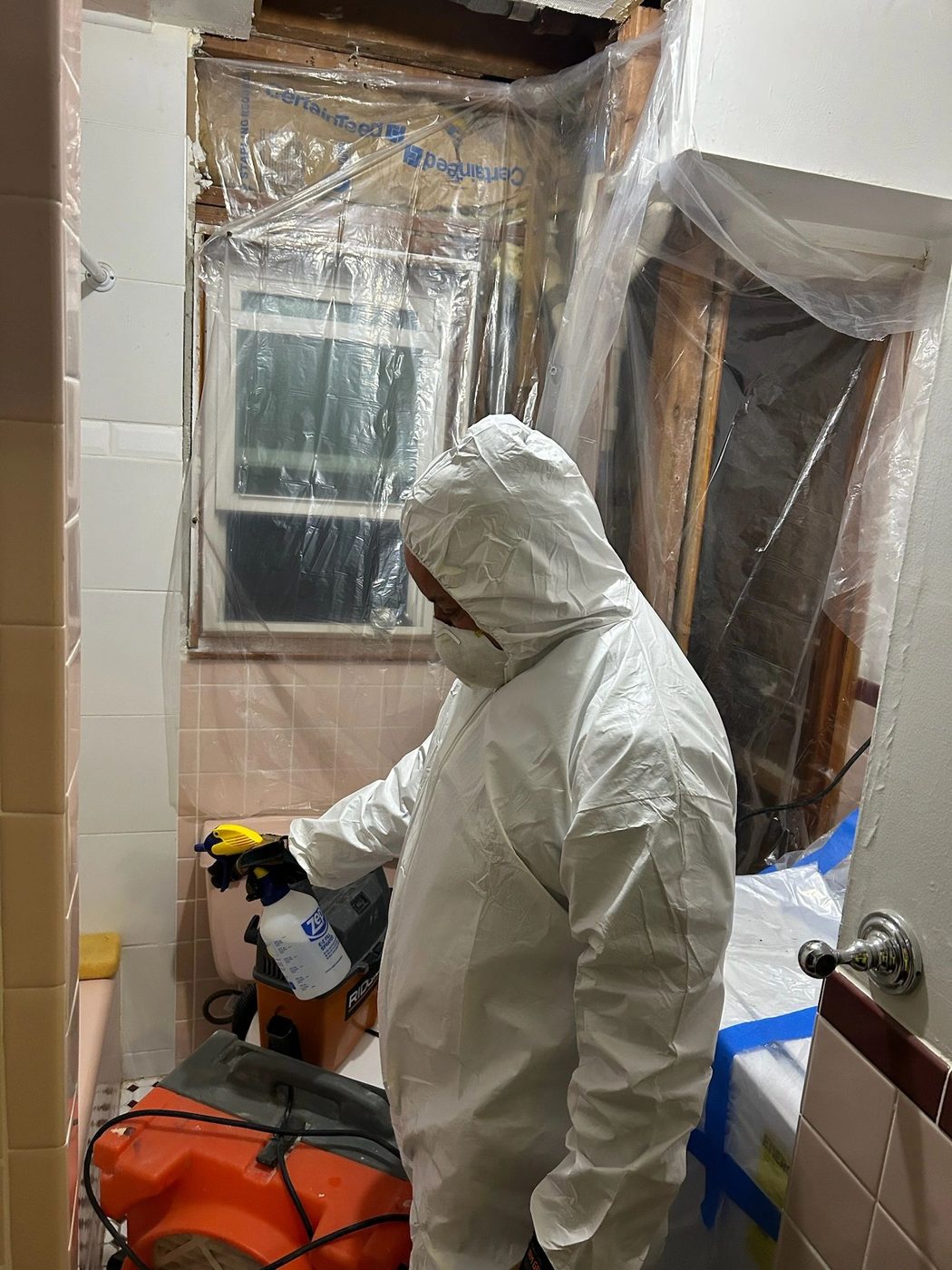
A GlobePro Restoration technician setting up containment and drying in a water-damaged bathroom.
What changes when the water is in a business
Many New York City businesses lease the space they work in. A shop or restaurant often sits on the ground floor under apartments, and an office suite often sits between other tenants on the same risers. A leak two floors up can end up in your ceiling, and a leak in your space can end up in the business below.
The materials are different too. Many offices have drop ceilings, and the EPA's water-damage table for schools and commercial buildings says wet ceiling tiles should be discarded and replaced. Wet carpet has to be pulled up and dried, along with its padding, because the EPA says a wet vacuum alone won't dry it. The same table notes that, depending on the size of the area, professional help may be needed to dry it quickly and thoroughly.
Then there is what is inside: inventory, equipment, files and the computers that run the business. NYC Emergency Management advises keeping copies of important records in a waterproof, fireproof, portable container, with a second set somewhere else, and backing up your data.
The kind of water matters more when customers come through the door. Clean water from a supply line is what the industry calls Category 1. Water with significant contamination, such as dishwasher discharge in a restaurant kitchen, is Category 2. Under the IICRC's S500 standard, examples of Category 3, grossly contaminated water can include sewage and waste-line backflow from beyond the trap, and for Category 2 or 3 water it calls for cleanup ahead of drying, with contamination controls and worker protection. For a restaurant, that matters: NYC Emergency Management's flood guidance is to throw away any food, packaged food included, that sewage water may have touched.
Who to call first in a commercial building
1. 911, if there is immediate danger, such as water near an electrical panel or a ceiling that is bulging. 2. Building staff or the managing agent. In a leased space, the valves that feed a riser or a sprinkler line are often out of your reach, in a basement or a mechanical room. 3. The tenants above and below. The source may be upstairs, and the water may already be downstairs. 4. Your insurance broker or carrier. Report the loss and ask what they need from you. 5. Someone to start the drying. GlobePro Restoration answers (929) 969-2534 24/7, which matters when a leak starts after closing. 6. The City, if the water came from its side. Report a sewer backup to 311. DEP says it will inspect within six hours of the complaint; heavy rain or a big snowmelt can slow that down. If you believe the City caused the damage, such as a backup from a city sewer main or a water main break (the line from the main to your building is the owner's to maintain), the NYC Comptroller says a notice of claim must be filed within 90 days through its website, using the Water Damage Claim Form.
Landlord, tenant and the lease
Who fixes what is set by your lease, not by where the puddle is. Many commercial leases put the building's structure and main systems on the landlord and the tenant's own fit-out, fixtures, equipment and inventory on the tenant, but the wording varies from lease to lease. Read the repair, insurance and casualty sections before anyone argues about who pays, and ask your attorney or broker if they are unclear.
Whatever the lease says, document the loss the same way. The state Department of Financial Services advises photos or video of the full damage before any cleanup, only the repairs needed to stop further damage, saved receipts, and permanent repairs held until the insurer has inspected the loss. Keep a simple log as well: the hours you were closed, staff you sent home, and stock you threw out.
Business interruption coverage: what it is, and what it isn't
Business interruption insurance, also called business income insurance, is the part of a business policy aimed at the cost of being closed. The National Association of Insurance Commissioners describes it as protection against losses from a period of suspended operations when a covered event causes physical property damage. It says these policies may cover costs such as rent or lease payments, relocation, employee wages, taxes and loan payments, and may reimburse revenue you would have earned had you stayed open.
There are limits worth knowing before you count on it:
- It depends on physical damage. The NAIC describes coverage as tied to physical damage from a covered event, so the cause of the water matters.
- Flood is usually separate. The NAIC says business interruption doesn't typically cover flooding, although additional coverage can be bought for it.
- It may not be in your policy at all. The NAIC says it is typically bundled into a businessowner's policy, and the Insurance Information Institute notes that some businesses, restaurants among them, may not be eligible for one.
- The wording decides. The NAIC's own advice is to read the specifics in your contract.
NYC Emergency Management lists business interruption, business income and extra expense insurance among the coverages worth reviewing before something goes wrong. If your business has been hit by a disaster, DFS says it can answer questions about business interruption insurance and off-premises service interruption coverage. GlobePro Restoration works with your insurance company to keep the process smooth, but only your insurer can tell you what your policy pays.
Commercial water damage restoration: drying and getting back open
GlobePro Restoration is a Brooklyn-based restoration company that answers 24/7. We track down every place the water got in, whether that is under your floor, inside a wall or in the space below you, and dry all of it. The repairs follow once everything is dry. If water is in your store, office or restaurant now, start with our 24/7 water damage restoration for New York City.
Speed is the reason to call early. The 24-to-48-hour window the EPA gives for drying starts when the water does, not when the business opens the next morning. Walls are a common place for water to hide, and our guide on when wet drywall needs replacing sorts what stays from what comes out.
If the drying comes too late and mold grows, larger buildings have their own rules. Under the city's Local Law 61, a covered building is one with 10 or more apartments, or on a lot with 25,000 square feet or more of commercial, office, retail, storage or factory floor area. In those buildings, mold work over 10 square feet has to be done by people licensed under New York's mold law, not by the owner, the managing agent or their staff, and in most cases the remediator has to notify the city two business days before starting.
Storm season adds its own risks for ground-floor and basement spaces. Our nor'easter preparation checklist covers catch basins, roof drains and backwater valves before the next one.
Frequently asked questions
Who pays for water damage in a commercial space?
It depends on where the water came from and what your lease says. Many leases split the building's systems from the tenant's fit-out and contents, so read the repair and insurance sections and ask your broker.
Does business interruption insurance cover water damage?
It can, when the water is a covered cause of physical damage under your policy. The NAIC says it typically doesn't cover flooding unless you bought additional coverage, so check your policy's wording with your broker.
Can I call after business hours?
Yes. GlobePro Restoration is open 24/7, so a leak found at closing time can be called in that night at (929) 969-2534.
What is the difference between commercial water damage clean up and restoration?
Clean up removes the water and anything that can't be saved. Restoration also covers finding where the water went and drying the building so the repairs can begin.
Will GlobePro Restoration coordinate with my insurer?
Yes. We work with your insurance company to make the claim process as smooth as possible. Your broker can confirm what the policy covers.
Water in your business right now?
Call (929) 969-2534 at any hour, or send a request and tell us what kind of space it is and what got wet. The rest of what we do is on the services page.
More from the blog
- Water Damage Restoration in Manhattan: Co-ops, Condos and Prewar Walk-Ups
- Water Leak From the Upstairs Apartment in NYC: First Steps and Who Pays
- Flood Cleanup in Brooklyn's Coastal Neighborhoods, 14 Years After Sandy
- Water Damage Restoration in Queens, NY: Basements, Attached Homes and Flash Floods
- Steam Pipe Burst or Radiator Leak in Your NYC Apartment: What to Do When the Heat Comes On