Basement Flooding Cleanup in Queens: What Ida Taught Woodside, Flushing and Hollis
Basement flooding cleanup in Queens goes in a set order: get everyone out and keep clear of electricity, report a sewer backup to 311, photograph the damage, pump the water out, remove what soaked it up, disinfect, and dry within 24 to 48 hours. During Ida, some of the water poured in through doors and windows and some rose out of the sewers through basement plumbing, and sewer water changes how a basement is cleaned. And as Ida showed in 2021, a flooding basement can be dangerous long before it is a cleanup job.
GlobePro Restoration is a 24/7 restoration company based in Brooklyn, and we cover Queens. Call (929) 969-2534 any time.
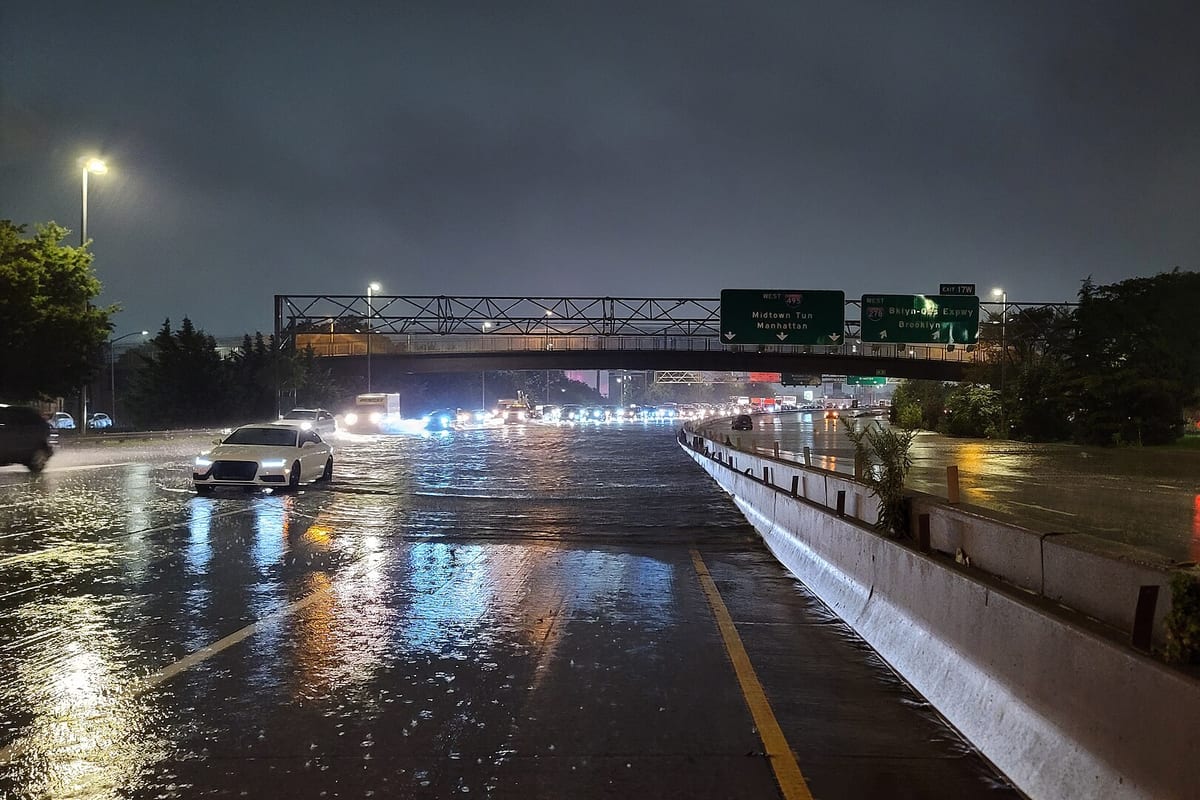
The Long Island Expressway during Ida's flash flooding, Sept. 1, 2021. Photo: Tommy Gao, CC BY-SA 4.0, via Wikimedia Commons.

What Ida did to Queens basements
The city's Ida recovery plan says the storm "smashed the City's record for the most single-hour rainfall" on the night of September 1, 2021, and that 13 people died in New York City. ABC7 reported deaths in Hollis, Flushing, Woodside and Forest Hills in Queens, and in Cypress Hills in Brooklyn. In Hollis and Flushing, the people who died were in basements. NBC New York reported that people died in six buildings, and that the Buildings Department confirmed illegal basement or cellar conversions in five of them.
The damage reached far more homes. Of about 33,500 damaged buildings citywide, 39.9% were in Queens, more than in any other borough. In one- to four-family homes, the city found, the damage was mostly in basements and ground floors, and it estimates that tens of thousands of New Yorkers live in illegal below-grade apartments.
Basement flooding cleanup in Queens, step by step
1. Get out, and stay out until it's safe. If water is rising in a basement during a storm, go upstairs or outside and don't go back down for belongings. Stay out of water that may be touching outlets, cords, appliances or the electrical panel. 2. Cut the power safely. If the panel is in the flooded basement, don't wade to it. Have your utility or an electrician shut it off. The city's clean-up guide also says not to run electrical equipment near standing water. 3. Report a sewer backup to 311. If the water came up through floor drains, toilets or sinks, owners file a Sewer Backup complaint and tenants file a Sewage Leak or Odor Indoors complaint. DEP says it inspects within six hours of a complaint, and heavy rain or snowmelt can slow that down. 4. Photograph it all before you move it. New York's Department of Financial Services wants the damage on photo or video before any cleanup, plus a room-by-room list of what was lost for your insurer. 5. Get the water out. A wet vacuum handles a shallow puddle; deeper water needs a pump. Run any gas-powered pump or generator outdoors, never in the basement. 6. Remove what soaked it up. DEP's after-storm guidance for one- to four-family homes is to remove wet items, drywall and flooring to prevent mold, and to note where the water got in. If the water was sewage, porous things that can't be cleaned, disinfected and dried, like carpet, padding, mattresses and upholstered furniture, go out. 7. Clean and disinfect. The IICRC S500 standard counts sewage among its examples of Category 3 water and puts cleanup of contaminated water before any drying. 8. Dry it fast. Per the EPA, drying wet materials within 24 to 48 hours usually keeps mold from growing. It also says not to use fans until you know the water is clean or sanitary.
GlobePro Restoration finds every place the water got in and dries out all the affected areas. Once everything is dry, the repairs begin. We work with your insurance company to make the process as smooth as possible. For 24/7 water damage restoration in Queens, call (929) 969-2534. If the water came up through a drain, our guide to sewage cleanup in NYC covers the 311 report and the 90-day deadline for a claim against the City, and water damage restoration in Queens covers the rest of the borough.
When basement water turns into a mold problem
Drywall, carpet backing, wood framing and cardboard boxes can stay wet for days in a closed basement, and that 24-to-48-hour window passes fast. The EPA says drywall can be dried in place only if there is no obvious swelling and the seams are intact; otherwise it has to come out. A basement wall can feel dry on its face and still be wet behind it.
If mold does take hold over a larger area, New York treats it as a licensed job. Under state labor law, mold assessment or remediation on more than 10 square feet requires a New York State Department of Labor license, and the same licensee can't do both the assessment and the remediation on one property. Owners working on their own home are exempt.
Basement apartments: what the city's rules say
HPD splits below-grade space in two. A basement is a story partly below curb level, with at least half its height above the curb; a cellar has more than half its height below it. Its rules say a cellar in a one- or two-family home can never be lawfully rented, and a basement in a one-family home can be rented only if conditions are met, including a ceiling of at least 7 feet and at least one window in every room.
The window rule matters in a flood. HPD notes that cellar windows are usually too small for an adult to fit through, so they rarely work as a way out. If you live below grade, know your route upstairs before a storm, not during one, and sign up for the city's Notify NYC alerts.
Queens ZIP codes GlobePro Restoration serves
- West Queens: 11368, 11369, 11370, 11372, 11373, 11377, 11378
- North Queens: 11354, 11355, 11356, 11357, 11358, 11359, 11360
- Jamaica: 11412, 11423, 11432, 11433, 11434, 11435, 11436
Frequently asked questions
What should I do first when my basement floods?
Get people out and keep everyone away from water near electricity. Then report a sewer backup to 311 if the water came up through a drain, photograph the damage and start getting the water out.
Who do I call when my basement floods in Queens?
911 if anyone is in danger, 311 for a sewer backup, your landlord or super if you rent, and your insurer. For the cleanup and drying, GlobePro Restoration answers (929) 969-2534 around the clock.
Does insurance cover a flooded basement?
Often not under a standard policy. DFS says homeowners and tenants policies exclude flooding, flood coverage comes from a separate National Flood Insurance Program policy that usually has a 30-day waiting period, and some insurers sell an add-on for sewer backups. Check your own policy.
How fast does a flooded basement need to be dried?
Within 24 to 48 hours if you can. That's the EPA's window for keeping mold from growing on wet materials.
Is it legal to rent out a basement in Queens?
Sometimes. Under HPD's rules, a cellar in a one- or two-family home is never legal to rent, and a basement only under specific conditions. Call 311 to ask about your building.
Water in your Queens basement?
Call (929) 969-2534, 24 hours a day, or send a request. GlobePro Restoration serves New York City and the surrounding areas.
More from the blog
- Oil Burner Puffback Cleanup: Soot After the Heat Kicks On
- Sewer Backup in NYC: Sewage Cleanup, Who to Call and How to File a Claim
- Water Damage Restoration on Staten Island: Detached Homes, Basements and the South Shore
- The Fire Damage Restoration Process, Step by Step: From Board-Up to Smoke Odor
- Water Damage Restoration in Manhattan: Co-ops, Condos and Prewar Walk-Ups